The Stablecoin Payment Gateway. 0.5% flat. 5 chains. We never hold your money.
Accept USDC and USDT across 5 blockchain networks. 0.5% flat fee, no rolling reserves, no chargebacks. On-chain settlement direct to your wallet. Funds never touch a PYMSTR balance sheet.
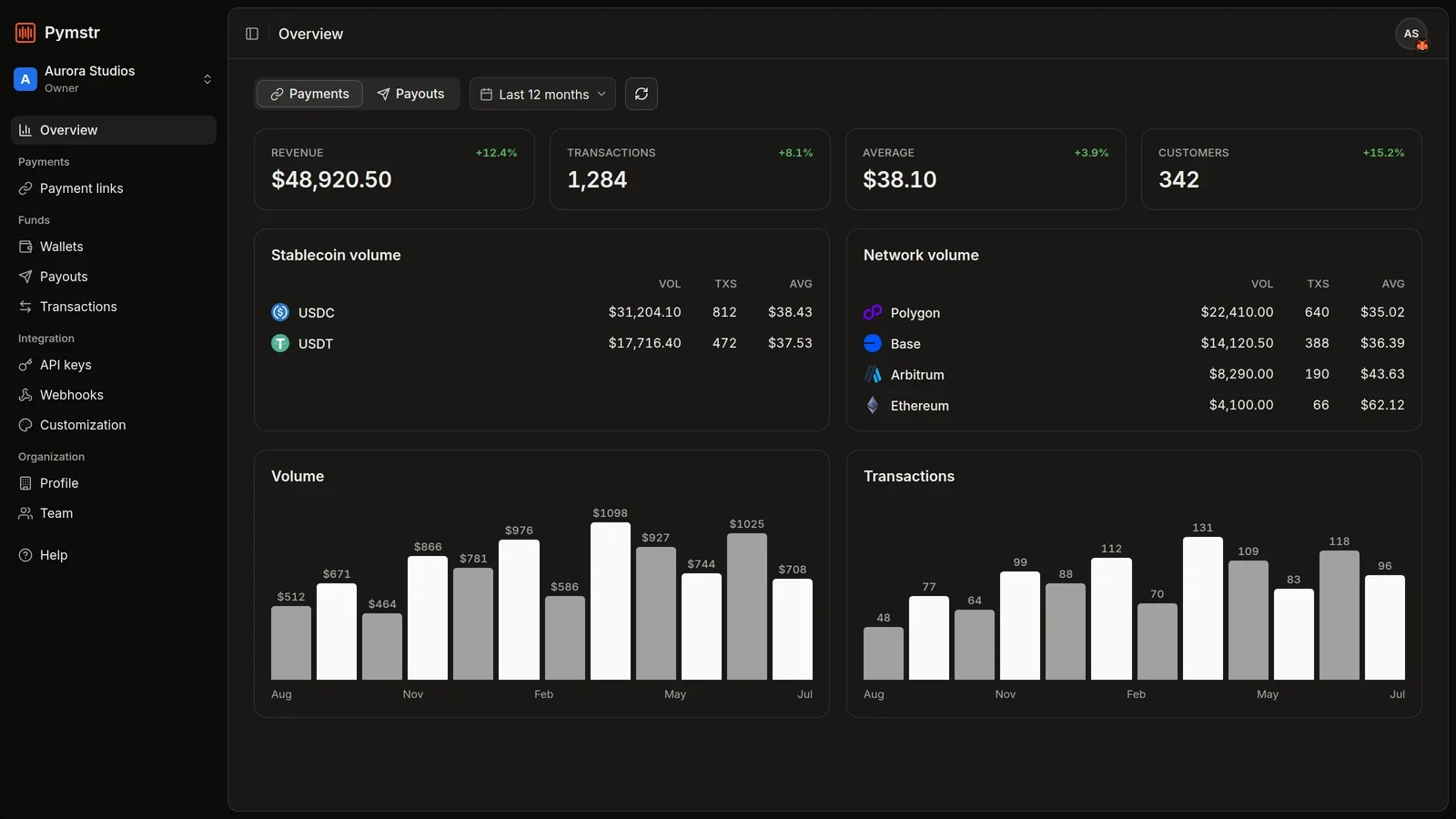
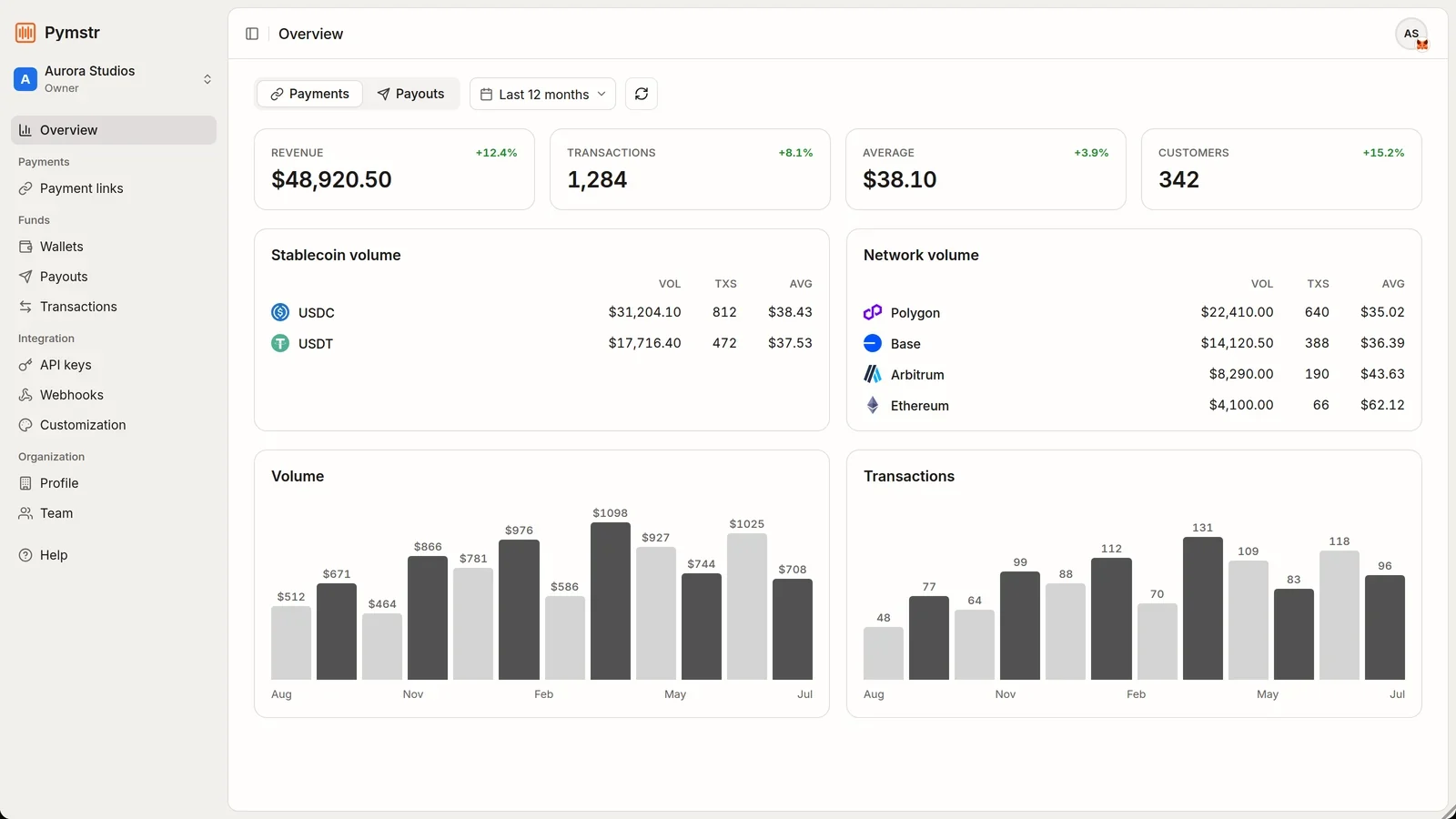
Why this exists
Most "crypto payment processors" inherit the worst parts of the card-rail business model and add a stack of new risks on top. They hold merchant funds in custodial hot wallets, which means an exchange-style breach drains every merchant on the platform at once (CoinsPaid lost $37M to a hack in July 2023, Alphapo $60M the same month). They accept hundreds of tokens, half of which are illiquid altcoins that bounce 10% between checkout and settlement, leaving merchants underpaid. They route customers through generic "pay with any wallet" flows that have no enforcement: a customer trying to pay in USDC on Polygon can accidentally send USDT on Ethereum, lose the funds to a wrong-token transfer, and now it's the merchant's support problem. And the fee model still mirrors the card-processor playbook: headline rate of 1%, but the all-in cost after FX spread, fiat withdrawal fees, monthly minimums, and inactivity charges lands at 2-3.5% in real practice.
PYMSTR is the stablecoin payment gateway that strips this category down to what merchants actually need. We accept exactly two stablecoins: USDC and USDT, both pegged 1:1 to the US dollar, both with combined market caps over $215B and the deepest on-chain liquidity in the market. No altcoins, no volatility. We run on five chains (Ethereum, Base, Polygon, Arbitrum, and BNB Smart Chain), and merchants choose which subset their checkout accepts so customers can't pick a chain that doesn't make sense for them. Payments settle on-chain directly from the customer's wallet to the merchant's wallet in 2-15 seconds depending on the chain. PYMSTR never holds the funds. There is no custodial hot wallet to hack, no rolling reserve to lock against future chargebacks (chargebacks don't exist on-chain), no merchant balance for an exchange-style breach to drain. Our fee is 0.5% flat, end to end, with no spreads, no withdrawal fees, no monthly minimums, no setup. The headline rate and the all-in cost are the same number.
Three steps, on-chain.
Customer selects stablecoin
Choose USDC or USDT. Enforced payments mean they can only use options you've approved.
Selects chain
Ethereum, Base, Polygon, Arbitrum, or BNB. Your merchant settings control which are available.
Pays exact amount
The exact amount transfers on-chain. No volatility between payment and settlement.
USDC payment gateway: how to choose one
A USDC payment gateway takes native USDC from a customer's wallet and lands it in the merchant's wallet in seconds. What separates one gateway from another is what happens in between: whether the provider holds the money on the way through (custodial: they hold your money) or whether it goes straight to you. PYMSTR never holds your money. The industry calls this non-custodial, and it is the single biggest difference between gateways that otherwise look alike.
Four things actually differ between USDC gateways. Who holds the USDC while it moves. Which networks the gateway takes it on, and whether that is native USDC or the older bridged USDC.e. What the all-in fee is once conversion spreads, fiat withdrawal fees, monthly minimums and rolling reserves are added to the headline rate. And what the provider refuses to do, or might stop doing altogether.
The 2026 picture makes the last point concrete. Coinbase Commerce closed its merchant portal on March 31, 2026 and its successor is Base only and USDC only. BitPay prohibits iGaming. CoinsPaid's 0.5-1.5% headline runs 2-3.5% all-in after spread, fiat withdrawal and inactivity fees, and it lost $44.5M to two hacks across 2023 and 2024 because it holds merchant funds. PYMSTR is 0.5% flat, takes native USDC on four networks, and never holds your money.
Check who holds the USDC
A custodial gateway pools your funds in its own hot wallet until it settles to you. A non-custodial gateway settles straight to your wallet with no balance in between. Every crypto payment gateway hack to date drained custodial balances.
Check which networks carry native USDC
PYMSTR takes native USDC on Ethereum, Base, Polygon and Arbitrum. Native only: bridged USDC.e is never accepted, so a customer cannot send you a token you cannot redeem 1:1.
Add up the all-in fee
Compare the headline rate plus conversion spread, fiat withdrawal fee, monthly minimum and rolling reserve. PYMSTR is 0.5% flat with none of the rest. The headline and the all-in cost are the same number.
Check restrictions and continuity
Vertical bans (BitPay excludes iGaming, Coinbase bans gambling everywhere), geography limits, and shutdown risk. Coinbase Commerce closed in March 2026. Pick a gateway that will still exist and still serve your vertical next year.
How iGaming operators take stablecoin deposits
For an iGaming operator, a deposit is a player paying through your PYMSTR checkout or payment link. The player chooses USDC or USDT on a network you allow, and the funds land directly in your operator wallet. Settlement is on-chain and fast: roughly 2 seconds on Base, Polygon, and Arbitrum, about 3 on BNB Chain, and around 15 on Ethereum. There is no processor balance in the middle and no multi-day settlement delay.
Enforced payments remove the most common deposit failure. You choose which chains and stablecoins your checkout accepts, and a player can only pick from those, so a deposit can never arrive on a network you do not support. That eliminates wrong-chain transfers and the lost-funds support tickets that come with them.
Once the network confirms, the deposit is final. There is no chargeback flow on the stablecoin rail, so a player cannot reverse a confirmed deposit weeks later the way a card deposit can be disputed, and no rolling reserve is held against your volume. Run it next to your card rail and route the crypto-native share of deposits through it.
Player picks coin and chain
At your checkout or payment link, the player selects USDC or USDT on a network you allow. Anything you have not enabled is not offered.
Player pays
They pay from a wallet created by their normal Google or Apple login, or connect their own. The exact amount, no conversion guesswork.
Funds land in your wallet
The deposit settles on-chain to your operator wallet in seconds and is final. You receive a webhook so your platform can credit the player.
How operators pay players out
The other side of a deposit is a cashout. With PYMSTR Payouts, a player withdrawal is a stablecoin transfer to the player, and you can batch up to 100 of them into a single on-chain transaction. Your platform creates the batch over the API as your withdrawal queue fills up, so cashouts are queued automatically instead of sent one by one.
Nothing moves until a person signs. Creating a payout produces a payout link, and you (or a teammate you hand it to) open it, connect a wallet, review the chain, coin, and total, and approve the batch. The wallet that opens the payout link is the one that signs and pays, usually your own; it does not have to be whoever created the payout, since the API can queue payouts but never move funds, so an automated queue can never pay itself out. The same flow covers affiliate commissions and vendor settlements, not just players.
The batch is atomic and non-custodial. Every player in the batch is paid together or the whole batch reverts, so one bad address cannot leave some players unpaid. Funds move straight from your wallet to the players, with no processor balance in the middle and nothing for a hack to drain. Pricing is 0.5% flat, charged on top, so players receive the full amount you entered.
Queue the withdrawals
Your platform creates a payout over the API as cashout requests come in, up to 100 players per batch, on one chain and one stablecoin.
A person approves
An authorized team member opens the payout link, reviews the total, and signs once. The API cannot move funds on its own.
Players are paid
One on-chain transaction pays every player at once, all or nothing, and a webhook fires when it completes.
Chain support: 5 networks
You choose which ones your checkout accepts.
| Network | Gas | Settlement | Stablecoins |
|---|---|---|---|
 Ethereum Ethereum | ~$2-10 | ~15 sec |   |
 Base Base | ~$0.05 | ~2 sec | |
 Polygon Polygon | ~$0.01 | ~2 sec | |
 Arbitrum Arbitrum | ~$0.10 | ~2 sec | |
 BNB Smart Chain BNB Smart Chain | ~$0.10 | ~3 sec | |
Stablecoin payment gateway: architecture comparison
| Processor | Rate | Architecture | Risk Profile |
|---|---|---|---|
| Traditional card (Nuvei, Worldpay, Paysafe; MCC 7995) | 5-10%+ | Card-rail | 2-3% chargebacks, 5-15% reserves locked |
| CoinsPaid | 0.5-1.5% (2-3.5% all-in) | Custodial | $37M hack July 2023 |
| BitPay | 1-2% + $0.25/tx | Custodial | iGaming excluded under AUP |
| NOWPayments | 0.5-1% | Custodial | Hot-wallet exposure |
| Coinbase Commerce | No published rate | Shut down Mar 2026; successor Base-only, USDC-only | Discontinuation risk |
| PYMSTR | 0.5% flat | Non-custodial | None. Funds never on PYMSTR balance sheet |
Three integration paths
What you get.
Zero Volatility
USDC and USDT are pegged 1:1 to USD. The amount paid is the amount received. Always.
Two Coins, Not 300+
Unlike NOWPayments with 300+ tokens, PYMSTR focuses on the two stablecoins that matter. Less confusion, fewer errors.
No wrong-coin mistakes
Customers can only pay with options you've approved. No wrong-chain, wrong-token, or wrong-amount errors.
Multi-Chain Efficiency
5 chains from $0.01 gas (Polygon) to $10 (Ethereum). Match the chain to the transaction size.
Short answers. No jargon.
Stablecoin Payments questions.
USDC and USDT have the deepest on-chain liquidity, the most established issuers (Circle and Tether), and a combined market cap above $215B. The marginal value of supporting a third or fourth stablecoin is near-zero for merchants and adds operational complexity (separate liquidity, separate redemption rails, more support edge cases). Two coins covers >95% of stablecoin payment volume in 2026 with no meaningful coverage gap.
Add stablecoin payments to your checkout.
0.5% flat. No chargebacks. Money lands in your own wallet in seconds.