The Instant Settlement Payment Gateway. Not in 3 to 7 days.
Instant crypto settlements built on stablecoin rails. USDC and USDT confirm to your wallet in 2-15 seconds, with no rolling reserves, no batch processing, no T+3 wait. This is the merchant's version of an instant settlement payment gateway.
Why this exists
Traditional payment processors run on T+1 to T+3 settlement for low-risk verticals and stretch to T+5 to T+7 for the high-risk ones (iGaming, forex, CBD, adult, telemedicine). Then they layer on rolling reserves: 5-15% of monthly volume held for 6+ months as chargeback insurance. On $500K monthly volume at a typical 10% reserve held for 6 months, that's 60% of one month's revenue ($300K) sitting in the processor's control at any given moment, earning nothing for the merchant. The opportunity cost compounds: capital that could be deployed in operations at 8%+ yields ~$24K/year in foregone return, just on the reserve. ACH parallels the same friction: T+1 to T+3 settlement, M-F NACHA cycles, no weekend or holiday processing, and a 60-day consumer reversal window that keeps payments provisional long after the bank reports them settled. When a processor extends the reserve unexpectedly (a chargeback ratio spike, a regulatory inquiry, a vertical re-classification), or terminates the relationship, the release schedule stretches to 12-18 months at the processor's discretion. The cash-flow shock takes months to unwind. Growth gets gated by a settlement schedule the merchant never agreed to.
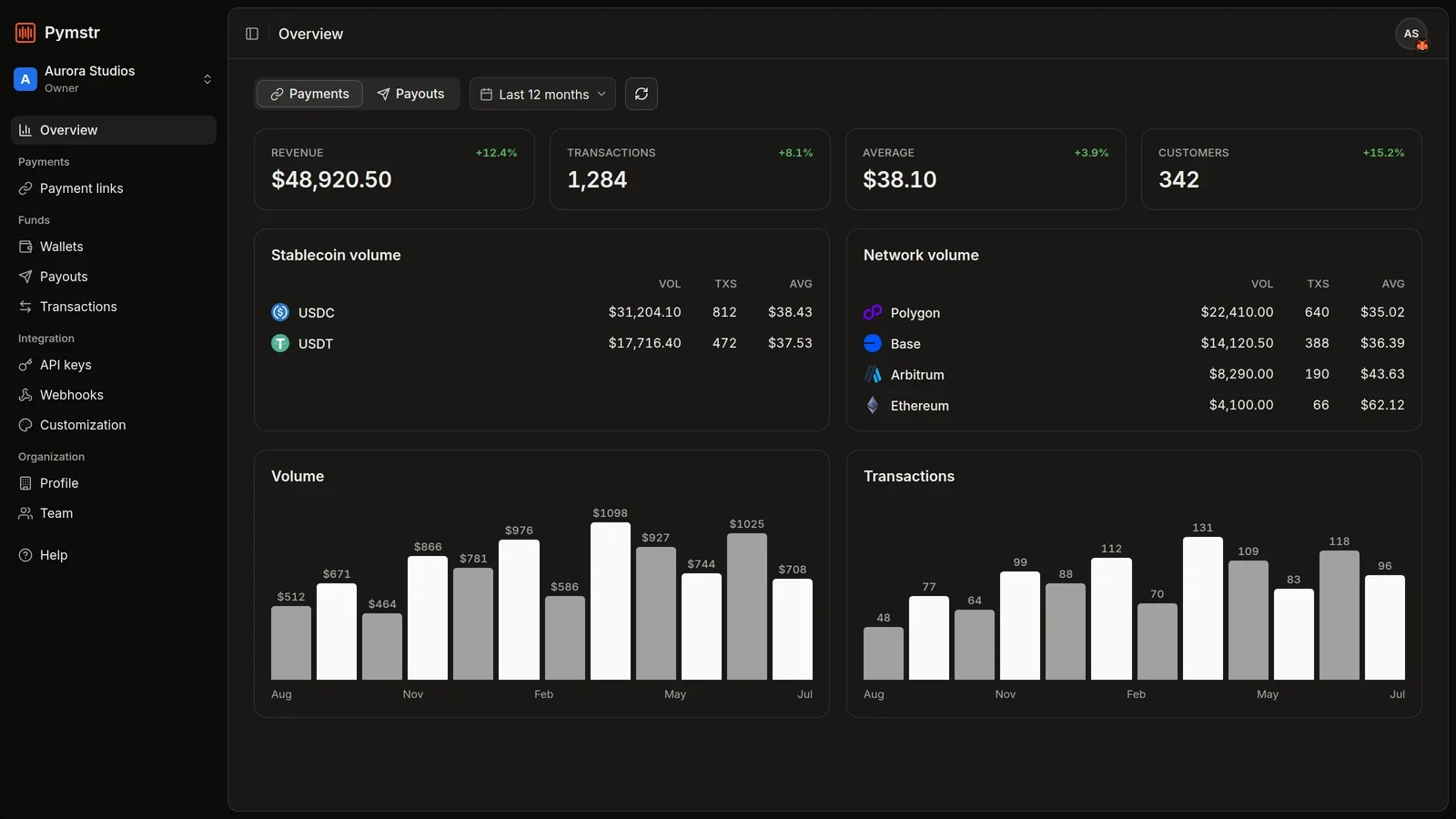
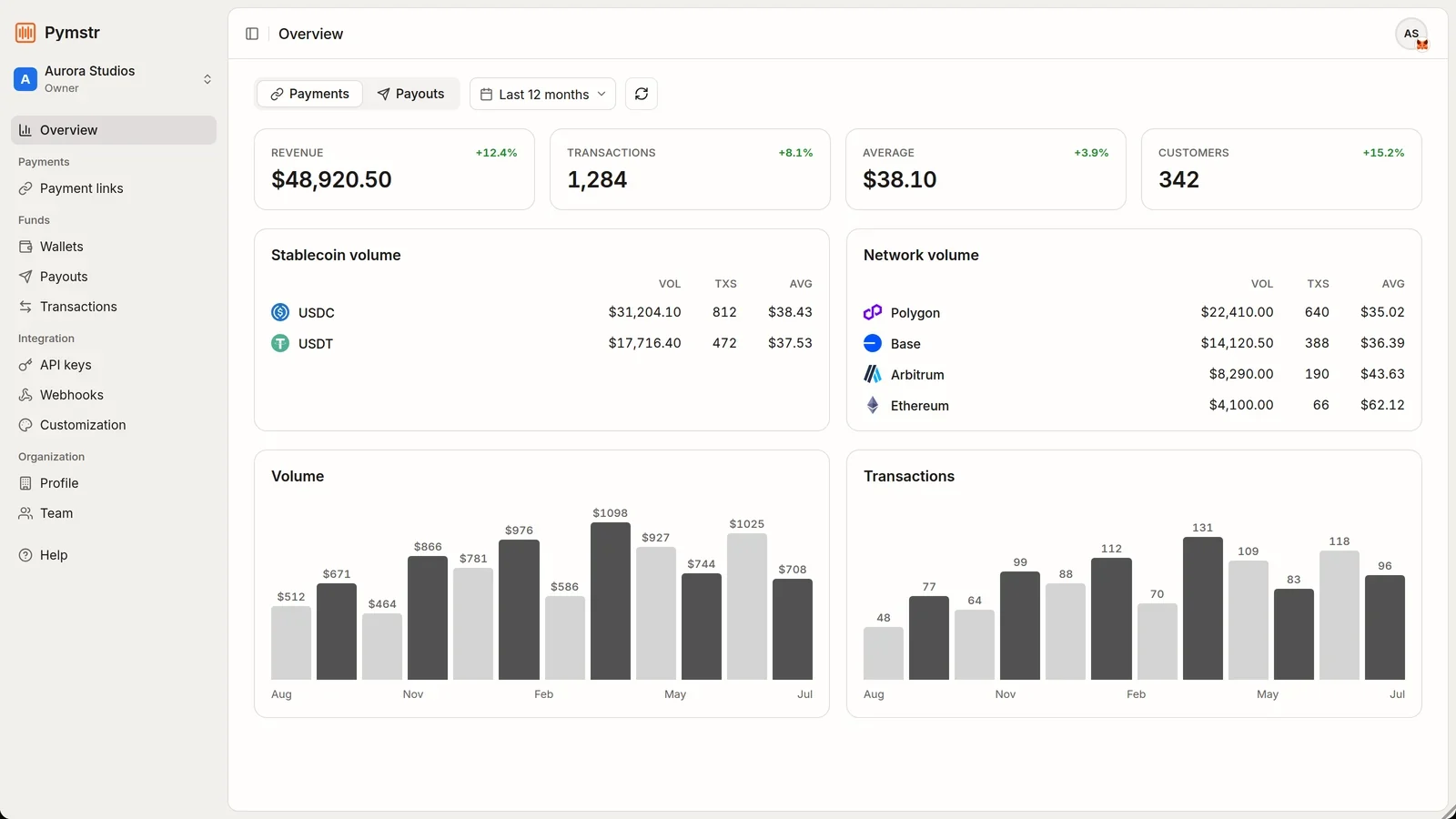
PYMSTR settles stablecoin payments in 2-15 seconds, on-chain, directly from the customer's wallet to the merchant's wallet. There is no clearing step downstream of block confirmation, no intermediary holding the money, no rolling reserve, no settlement holiday. The finality is protocol-level. Once a USDC or USDT transfer is included in a confirmed block, the funds are the merchant's, period. Not because PYMSTR chose to release them, but because the chain validators decided the block is canonical and there is no further authority to override. The rail is 24/7: blockchains don't close for weekends, holidays, or end-of-day batches. A Saturday 3 a.m. payment confirms in the same window as a Tuesday 11 a.m. payment. Chain selection becomes a deliberate lever rather than a constraint: Ethereum for high-value transactions where maximum settlement security matters, Base or Polygon for low-fee small-ticket payments, Arbitrum or BNB Smart Chain for the regional mix in between. And because the rail denominates in stablecoins pegged 1:1 to USD, there is no FX exposure between the moment of payment and the moment of use. The dollar value you accept is the dollar value you can spend in the next minute.
Three steps, on-chain.
Customer pays
Stablecoins transfer on-chain from customer to your wallet.
Chain confirms (2-15 sec)
Base/Polygon: ~2 sec. Arbitrum: ~2 sec. BNB: ~3 sec. Ethereum: ~15 sec.
Funds available immediately
Stablecoins are in your wallet. Use them, hold them, or off-ramp to fiat. Your choice.
Chain finality: 5 networks
You choose which ones your checkout accepts.
| Network | Gas | Settlement | Stablecoins |
|---|---|---|---|
 Ethereum Ethereum | ~$2-10 | ~15 sec |   |
 Base Base | ~$0.05 | ~2 sec | |
 Polygon Polygon | ~$0.01 | ~2 sec | |
 Arbitrum Arbitrum | ~$0.10 | ~2 sec | |
 BNB Smart Chain BNB Smart Chain | ~$0.10 | ~3 sec | |
Instant settlement: payment rail comparison
| Rail | Settlement window | Reserves | Weekends + holidays | Final by |
|---|---|---|---|---|
| Card (Visa, Mastercard): high-risk verticals | T+5 to T+7 | 5-15% of monthly volume, 6+ months | No settlement (banks closed) | Issuing-bank schedule |
| ACH | T+1 to T+3 | None | No settlement (NACHA cycles, M-F) | NACHA windows + bank discretion |
| Custodial crypto PSP (CoinsPaid, BitPay, NOWPayments) | Hours to days at custodian discretion | None | Slower weekend processing | Custodian operations |
| PYMSTR (non-custodial stablecoin) | 2-15 seconds | None | 24/7 always-on (blockchain doesn't sleep) | Final once the network confirms |
What you get.
Cash Flow Certainty
Know exactly when funds arrive. No 3-7 day uncertainty, no batch processing delays.
No Rolling Reserves
Traditional processors hold 5-15% for 6+ months. On $500K monthly volume, that's up to $300K locked. PYMSTR holds nothing.
Capital Efficiency
Use funds immediately. Reinvest in operations, pay suppliers, distribute winnings. No waiting.
Predictable Operations
Every payment settles in seconds. No late-arriving batches, no weekend delays, no holiday processing freezes.
Short answers. No jargon.
Instant Settlement questions.
An instant settlement payment gateway settles funds to the merchant within seconds rather than days. Traditional gateways batch transactions and release them to your bank account on T+3 to T+7 schedules; PYMSTR is an instant settlement payment gateway that finalises each stablecoin payment individually on-chain in 2-15 seconds, directly to a wallet you control.
Add stablecoin payments to your checkout.
0.5% flat. No chargebacks. Money lands in your own wallet in seconds.